How to Edit Videos With Claude Code: 4 Setups Tested Blind
Can Claude Code turn a clip into a YouTube Short?
Claude Code can use editing tools to cut footage, add captions and render a vertical video. Here you can watch the original clip and compare four different edits made from it.
Key takeaways
- Best score: Remotion. Clean captions and a good hook earned 21/25.
- Lowest cost: MoviePy + FFmpeg. The documentation-only control cost $0.73.
- All four finished unaided. Each delivered a short in 3.2 to 7.2 minutes.
- Same conditions, recorded costs. The clip, instruction, model and worker limits stayed fixed.
Original clip · 20.4 seconds
Watch the four shorts · Nov 15, 2026
Setup
- Source: a 20.4-second excerpt of President Obama at the 2015 White House Correspondents' Dinner, from the Obama White House archive (public domain)
- Instruction: identical for every setup: make one 1080 by 1920 short from this clip with the installed skills, without asking questions
- Agent: Claude Code with Claude Opus 5.5; only the skills differ
Clone it yourself
Clone the video-editing demo. You'll need Node 22.16 or later and Docker (Docker Desktop or Colima).
 Try it on GitHubAgentic Video Editing
git clone https://github.com/intelligent-iterations/agentic-video-editing.git
cd agentic-video-editing
npm ci
npm run demo
What did we test?
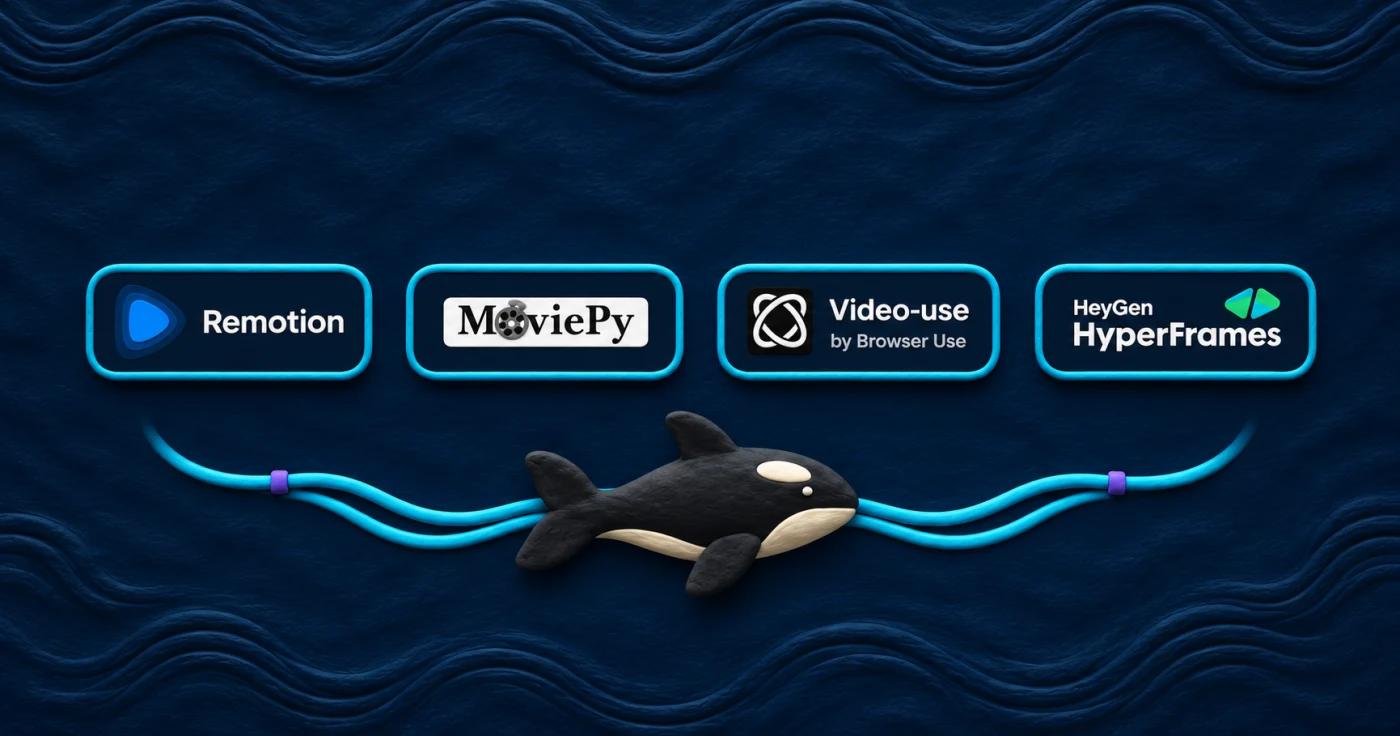
Four setups of Claude Code, using published skills or library documentation:
- Remotion: the official Remotion skills, including captions.
- HyperFrames: HeyGen's official skills, including a talking-head recut.
- Video-use: Browser Use's community skill for editing talking-head video.
- MoviePy + FFmpeg: no skill at all, only the library's documentation. This is the control.
Each got the same 20.4-second excerpt of President Obama at the 2015 White House Correspondents' Dinner and the same instruction: make one vertical short with the installed skills, and don't ask questions. The instruction said nothing about hooks, style or B-roll, on purpose: we wanted to see what each skill does on its own.
One judge scored four shorts blind. The clips were shuffled and re-encoded identically. Five criteria each carried 1 to 5 points: hook, story and payoff, pacing, faithfulness to what was said, and captions and framing. This is a small pilot with one clip and one judge.
What did the judge prefer, and why?
The judge preferred Remotion's edit for its clean captions and opening hook. It was easy to follow, though the judge wanted more than captions alone. MoviePy + FFmpeg came second; its edit put too much text on screen.
Video-use and HyperFrames tied for the lowest score. Video-use put a transcription error on screen, writing "him" where Obama says "them". HyperFrames' hook text was hard to read and its look overstimulating.
The table adds the five judging criteria into a score out of 25. Higher scores mean the judge preferred the edit; they do not measure audience engagement.
Blind ratings · Nov 15, 2026
Setup
- Run:
20261115-claude-matched-obama-slack, four scored setups, one short each - Judging: one judge, four clips shuffled, re-encoded identically with metadata stripped, names revealed after scoring
- Criteria: hook, story and payoff, pacing, faithfulness to the source, captions and framing, each from 1 to 5
| Setup | Its skills are for | Score / 25 | Judge's note |
|---|---|---|---|
| 1. Remotion | Code-built video, with an official captions skill | 21 | Clean captions and a good hook line, but basic: captions and little else. |
| 2. MoviePy + FFmpeg | No skill, only the library's documentation | 17 | Too much text on screen; a bland edit. |
| 3. Video-use | Editing talking-head video by conversation | 15 | A caption says "him" where he says "them", copied from the machine transcript. |
| 3. HyperFrames | HTML video, with a talking-head recut skill | 15 | Hook text hard to read; a busy, overstimulating look. |
What did each short cost?
$0.73 to $1.53 per short at API list prices, and 3.2 to 7.2 minutes. All four setups finished in under eight minutes for under $1.60.
Together, the four runs used approximately 5.27 million tokens across 103 model calls, worth $4.50 at list price. Their combined agent time was 18.9 minutes. They ran on a Claude Max plan, so the additional token charge was $0.
Live runs · Nov 15, 2026
Setup
- Run:
20261115-claude-matched-obama-slack, Claude Code with Claude Opus 5.5 - Worker: one per setup, 2 CPUs, 2.75 GiB of memory, 10 GiB of disk, a 55-minute limit
- Source of the numbers: the gateway's log of every model call, including calls made by helper agents
- Cost: those tokens at API list price; the runs used a Claude Max plan, so the actual charge was $0
| Setup | Score / 25 | Agent time | Model calls | Tokens | Cost |
|---|---|---|---|---|---|
| Remotion | 21 | 3.2 min | 20 | 0.87M | $0.79 |
| MoviePy + FFmpeg | 17 | 3.9 min | 21 | 0.75M | $0.73 |
| Video-use | 15 | 7.2 min | 32 | 1.49M | $1.45 |
| HyperFrames | 15 | 4.6 min | 30 | 2.16M | $1.53 |
| All four | 18.9 min | 103 | ~5.27M | $4.50 |
How did II Agent Runtime make the test fair?
One task · Four independent edits





A comparison like this only means something if nothing but the skills changes. II Agent Runtime gave every setup an identical, sealed worker: 2 CPUs, 2.75 GiB of memory, 10 GiB of disk and a 55-minute limit, each built from a pinned image and destroyed when the run ended. No setup could get more compute or more time than another.
Claude Code never held the real login. It got an expiring token for a gateway that logged every model call, including calls from helper agents that Claude Code's own totals leave out. Those logs are where the time, token and cost figures come from.
Every run leaves a record you can check: the hashes of the clip and the instruction, the limits, the checkpoints the runtime passed, checks on every exported video, and proof that the worker was cleaned up. Rerun a setup and you get the same conditions and the same measurements, which is what turns a one-off demo into a template you can test against.
What will we change in the next test?
- A better prompt. This instruction never said what makes a short engaging. The next one will ask for a hook in the first three seconds, a clear payoff and readable captions, so the skills compete on craft, not guesswork.
- B-roll from the web. Let the agent search the web for footage and images that illustrate what's being said, and cut them in.
- Blender for animation. Connect Claude Code to Blender, so it can build richer animated scenes than 2D motion graphics.
We'll rerun these four setups and add more clips and judges, keeping the conditions fixed so the scores and costs remain comparable.
Frequently asked questions
Which Claude Code video skill should I start with?
For a captioned talking-head short, start with Remotion's official skills: they made the best-scoring short in this four-way test, quickly and cheaply.
How much does it cost to edit a video with Claude Code?
In our runs, $0.73 to $1.53 per 20-second short at API list prices with Claude Opus 5.5. On a Claude subscription, it counts against your plan's usage instead.
Can Claude Code edit a video without supervision?
Yes. All four setups ran with no human answers and finished in 3.2 to 7.2 minutes. Some skills ask for approval by design; ours were told to proceed without asking.
Can I test my own skill the same way?
Yes. Add your editor image and skills as a new setup, keep the clip, instruction and limits, and run it. You get the same records, so your numbers line up with these.
Is one judge enough?
It's a first signal, not a verdict. The judging was blind, but more judges and more clips will make the ranking firmer, and the template makes adding both cheap.
Built on II Agent Runtime
Every short here ran in an II Agent Runtime worker, with the same limits and the same records. Explore the runtime behind the demo:
intelligent-iterations / ii-agent-runtimeSecure. Deploy. Measure. Open infrastructure for agent harnesses.
View runtime